

Window Graphics: Turn Your Storefront into a 24/7 Billboard
Transform your storefront into a 24/7 billboard! Discover how store window graphics, from decals to lettering, boost visibility, attract customers, and enhance your brand.
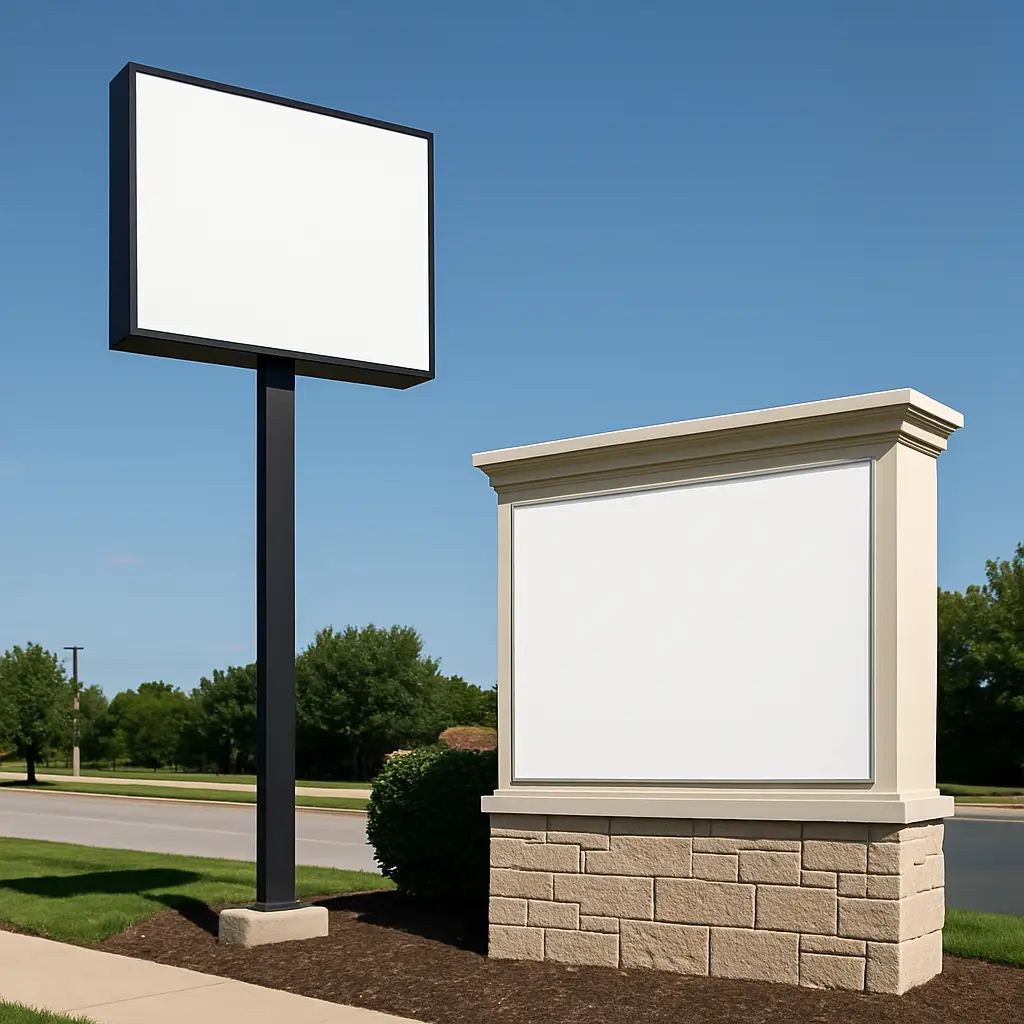
Your business sign is often the very first handshake you offer a potential customer. This crucial piece of outdoor signage works 24/7 to capture attention, guide visitors, and communicate your brand’s presence. When it comes to prominent, freestanding signs, the choice often boils down to two powerful options: pylon signs and monument signs. While both are effective business signs, they serve distinct purposes and project very different images. The core debate of pylon vs monument signs is about more than just height; it’s a strategic decision based on your location, brand identity, and visibility needs. A towering pylon sign grabs attention from a distance, while a grounded monument sign conveys permanence and elegance up close. This guide will break down the key differences to help you decide which type of sign is the perfect first impression for your unique business.
Before diving into the specifics of pylon vs monument signs, it’s crucial to understand the fundamental job of any effective outdoor signage. These structures are far more than just location markers; they are your business’s tireless, 24/7 brand ambassador. A well-designed business sign serves several key functions: it enhances sign visibility to attract passing traffic, provides clear wayfinding for visitors, and solidifies your brand identity in the physical world. For many customers, your sign is the first tangible interaction they have with your company, setting expectations for quality and professionalism. Choosing the right type of freestanding sign is therefore a strategic investment in your marketing. It dictates how effectively you communicate with your target audience and stand out in a crowded marketplace, making the decision between different options a vital one for your long-term success.
Effective outdoor signage is a direct driver of business success, acting as one of your most cost-effective marketing tools. It transforms passing drivers and pedestrians into potential customers by boosting brand recognition and physically guiding them to your location. A strategically chosen sign can significantly increase foot traffic and sales, offering an impressive return on investment. The choice between different business signs, therefore, isn’t just aesthetic—it’s a financial calculation that directly impacts your bottom line and ability to compete in your local market.
The core of the pylon vs monument signs debate hinges on a few critical business factors. This isn’t merely an aesthetic preference; it’s a strategic choice about function and communication. The right decision depends on your specific visibility needs—do you need to be seen from a highway or a local street? It also reflects your brand identity, weighing maximum exposure against sophisticated permanence. Finally, local signage regulations often dictate what is possible. Understanding these key considerations is the first step toward making an informed decision.

Pylon signs, frequently referred to as pole signs, are the towering giants of the signage world. These tall, freestanding signs are engineered with one primary goal in mind: maximizing sign visibility from a significant distance. They are the ideal choice for businesses located near major highways, busy thoroughfares, or those set back from the road where they might otherwise be missed. Structurally, these business signs typically feature one or more large poles supporting an illuminated sign cabinet. This cabinet can be dedicated to a single brand or designed to accommodate multiple tenants, making them a staple for shopping centers and business parks. Their impressive height cuts through visual clutter to capture the attention of fast-moving traffic, making them a powerful directional tool. However, their scale means that pylon signs are heavily scrutinized under local signage regulations, which can strictly limit their height and placement.
A pylon sign, also commonly called a pole sign, is a tall freestanding sign defined by its vertical structure. It consists of one or more steel poles anchored to a foundation, which elevate a large sign cabinet high above the ground. These business signs are engineered for maximum height—often ranging from 15 to over 80 feet—to ensure visibility over obstacles and from long distances. This elevation is the key structural element that distinguishes pylon signs in any outdoor signage comparison.
The paramount advantage of pylon signs is their exceptional sign visibility. By towering over nearby buildings and landscape features, these freestanding signs act as powerful beacons, capturing the attention of potential customers from a great distance. This long-range impact is crucial for businesses located near highways or busy roads, giving fast-moving drivers ample time to see your brand and safely navigate to your entrance. In a competitive environment, the ability of these business signs to serve as a landmark provides a distinct strategic edge.
You’ll typically find pylon signs in environments where being seen from afar is non-negotiable. Along highways and major roads, these freestanding signs are essential for attracting fast-moving traffic. Shopping centers and plazas frequently rely on multi-tenant pylon signs as a visual directory, announcing all available businesses to potential customers from the main street. Similarly, industrial parks use these towering business signs to guide visitors and deliveries to specific companies located deep within a complex, making them indispensable for both marketing and navigation.
While their visibility is unmatched, pylon signs come with significant considerations. The initial signage cost is typically higher due to the complex engineering, materials, and foundation required for their impressive height. Securing approval can also be challenging, as these structures face strict local signage regulations that govern size and placement. Aesthetically, their focus on function over form means they may not offer the same sophisticated, integrated look as other outdoor signage, sometimes clashing with a brand aiming for a more subtle, high-end feel.
In stark contrast to the towering height of pylon signs, monument signs make their impact at eye level. These are low-profile, freestanding signs built on or close to the ground, often appearing as a seamless extension of the property’s landscaping and architecture. Constructed from durable and high-end materials such as brick, stone, stucco, or concrete, monument signs are designed to convey permanence, quality, and prestige. Their purpose isn’t to shout from a highway but to create a sophisticated and welcoming first impression for visitors arriving at your entrance. For businesses like corporate offices, medical facilities, and upscale retail locations, the choice in the pylon vs monument signs debate often leans toward this grounded option. A monument sign communicates stability and integrates beautifully with its surroundings, making it a powerful piece of outdoor signage for brands focused on elegance and a strong, established presence.
A monument sign is a type of freestanding sign defined by its low-profile, ground-level construction. Rather than being hoisted on poles, it rests on a solid base or is built as part of the landscape. These business signs are typically constructed from durable, high-quality materials like brick, stone, concrete, or stucco to create a sense of permanence and stability. This architectural approach allows the outdoor signage to seamlessly blend with the property’s design, presenting a polished and cohesive brand image at eye level.
The primary advantage of monument signs lies in the sophisticated brand image they project. These freestanding signs are crafted to look like a natural extension of your property, allowing for seamless architectural integration with your building and landscaping. This creates a cohesive, high-end first impression. Constructed from robust materials, these business signs offer exceptional durability against the elements, making them a long-term investment. This combination of elegance and permanence communicates quality and stability to every visitor who arrives at your entrance.
Monument signs are the ideal choice for locations prioritizing a sophisticated and integrated brand image. You’ll find these freestanding signs at the entrances of corporate campuses, where they convey professionalism and stability. Upscale residential communities and apartment complexes use them to create a welcoming, high-end landmark for residents and guests. They are also common for professional services like medical clinics, law offices, and hotels, where the business sign must communicate trust and blend seamlessly with the building’s architecture, marking the property with understated elegance.
The primary trade-off with monument signs is their intentionally limited sign visibility. Their elegant, low-profile design is not built to capture attention from far away, making them less effective for businesses set back from the road or needing to attract fast-moving highway traffic. These freestanding signs also require a suitable location at the property’s entrance with enough setback to be impactful. If your business lacks this frontage, a monument sign might be overlooked by potential customers, a crucial consideration in your decision.
Now that we’ve explored the individual characteristics of pylon and monument signs, let’s place them side-by-side for a direct comparison. The choice in the pylon vs monument signs debate is not about which type of outdoor signage is inherently superior, but which one aligns with your specific strategic goals. At its core, the decision boils down to a fundamental trade-off: long-distance visibility versus ground-level sophistication. Pylon signs are engineered to be functional beacons, maximizing reach and capturing the attention of fast-moving traffic from afar. In contrast, monument signs act as elegant architectural statements, designed to welcome visitors and reinforce a high-end brand identity upon arrival. Understanding how these opposing strengths match up against your business location, brand image, typical signage cost, and local signage regulations is the key to making the right investment for your company’s future.
This is the central conflict in the pylon vs monument signs decision. Pylon signs are built for maximum sign visibility from a distance, acting as beacons for fast-moving traffic on highways and busy streets. Their impact is directional and informational. In contrast, monument signs deliver an immediate, up-close impact. They are architectural freestanding signs designed to impress visitors as they arrive, conveying quality and permanence right at the entrance. The choice is between being seen from afar or making a statement upon arrival.
Your brand’s personality is a critical factor in the pylon vs monument signs debate. Pylon signs project a bold, high-impact image. Their aesthetic is driven by function—to be seen clearly and from afar. This makes a powerful statement about accessibility and presence, ideal for brands targeting mass audiences or emphasizing convenience. Conversely, monument signs provide an elegant welcome. This type of outdoor signage uses high-end materials to create an architectural feature, conveying permanence and sophistication, aligning perfectly with brands that build on trust and a premium image.
Generally, the upfront signage cost for pylon signs is higher. This is due to the complex engineering, deep concrete foundations, and the need for heavy machinery like cranes for installation. In contrast, the cost for monument signs is more variable and depends heavily on the materials chosen—custom stonework will be more expensive than a simpler stucco finish. However, their installation is typically less complex. This financial investment is a practical and crucial factor when weighing pylon vs monument signs for your business.
Local signage regulations can be the ultimate deciding factor in the pylon vs monument signs debate. Municipalities often impose strict height, size, and setback restrictions on towering pylon signs, which can limit or even prohibit their use. While monument signs are frequently favored for their lower impact, they are still governed by local codes. Checking with your city’s zoning department is a critical, non-negotiable first step before investing in any new business signs.
When considering pylon vs monument signs, long-term durability is a key differentiator. Monument signs generally have the edge, as they are constructed from robust materials like brick and stone that endure weathering with minimal upkeep. Their ground-level placement makes cleaning and landscaping simple. While durable, pylon signs face different challenges; their height exposes them to greater wind loads and makes servicing lights or cleaning faces a more complex task, often requiring a bucket truck. This difference in accessibility and upkeep for your outdoor signage is an important long-term consideration.

Making the right choice in the pylon vs monument signs debate comes down to a clear-eyed assessment of your specific circumstances. The ideal piece of outdoor signage is the one that best serves your strategic goals. Begin by analyzing your location: do you need to capture attention from a distant highway, making the superior sign visibility of a pylon sign essential? Or is your primary goal to create a sophisticated, welcoming impression at your property’s entrance, where a monument sign excels? Next, evaluate your brand identity. Are you communicating bold convenience or established prestige? Finally, practical constraints like your budget for signage cost and local signage regulations are non-negotiable. Answering these core questions about visibility, branding, and logistics will illuminate the clear path forward, ensuring you invest in a business sign that delivers the right message and the best return for your unique company.
The physical placement of your business is the most critical factor in this decision. Is your building set far back from the road, obscured by other structures, or located near a high-speed thoroughfare? If so, the long-distance sign visibility offered by pylon signs becomes essential for guiding customers. Conversely, if your property has a shallow setback and clear sightlines from a slower street, a monument sign can create a powerful, sophisticated impression right at the curb, making it the more logical choice.
Who are you trying to reach and how fast are they moving? This is a crucial question in the pylon vs monument signs decision. If your audience is primarily commuters traveling at high speeds, the superior sign visibility of a pylon sign is essential to capture their attention in time. However, if you serve local clients or pedestrians in a slower-paced area, the up-close elegance of a monument sign reinforces quality and professionalism, making a stronger, more personal impression on your target customers.
Your outdoor signage is a direct reflection of your company’s personality. When deciding between pylon vs monument signs, consider the image you want to project. Do you want to be seen as a bold, convenient, and high-traffic destination? The commanding presence of pylon signs achieves that. Or is your brand built on trust, prestige, and sophistication? The architectural elegance of monument signs perfectly conveys that message. The right choice reinforces your brand values before a customer even steps inside.
Your budget is a practical factor that can quickly narrow the pylon vs monument signs choice. Generally, pylon signs have a higher initial signage cost due to complex engineering and installation requirements. While monument signs can seem more affordable, custom materials like stone can be expensive. Think beyond the purchase price to long-term upkeep. Servicing a tall pylon sign may require a bucket truck, whereas a ground-level monument sign is far easier and cheaper to maintain.
The debate over pylon vs monument signs ultimately comes down to your business’s unique strategic needs. There is no single “best” answer, only the type of outdoor signage that best serves your goals. A pylon sign is an unmatched tool for maximizing sign visibility from a distance, making it essential for businesses near highways or those needing to stand out in a crowded commercial landscape. In contrast, a monument sign acts as an elegant, architectural statement, conveying permanence and quality to visitors right at your entrance. Your final choice is a calculated investment. It requires balancing your location’s requirements against your brand identity, your budget for the initial signage cost and upkeep, and the non-negotiable realities of local signage regulations. By carefully weighing these factors, you can invest confidently in the type of sign that will serve as the most effective ambassador for your brand, ensuring your business signs work tirelessly to drive success for years to come.
Transform your storefront into a 24/7 billboard! Discover how store window graphics, from decals to lettering, boost visibility, attract customers, and enhance your brand.

Choosing the best CMS for your business? Compare WordPress, Shopify, and Squarespace side-by-side to find the ideal platform for your online store or website.

Master choosing the right fonts for your brand. Learn font psychology, pairing, and legibility to craft a powerful brand identity that connects with your audience.